
Alone or With Others: Which Way to Spiritual Growth?

The spiritual journey is personal. No one else can meditate for us, discover our inner self for us, or experience God for us.
But does that mean we should pursue spiritual growth alone?
Not necessarily.
A spiritual community can provide encouragement, energy, friendship, and support that are difficult to create by ourselves. At the same time, Michael Gottlieb, master teacher and founder of Royal Way Spiritual Center, teaches that learning to be truly alone is essential to discovering who we really are.
So which way to spiritual growth is better—alone or with others?
The answer is both. Let’s examine why.
Can You Take the Spiritual Journey Alone?
First, it’s important to understand that learning to be truly alone has profound benefits. And that “alone” is not the same as “lonely.”
We sometimes confuse the two. We assume that if we are alone, something is missing. So we fill the space with activity, television, phones, work, music, conversation, or almost anything that keeps us from truly being alone.
Michael Gottlieb teaches something quite different.
“To learn how to be sacred, one must first learn how to be alone,” he writes. He adds that being alone requires courage—because people often fear loneliness without realizing “that being alone does not cause loneliness, and having someone does not cure loneliness.”
This beautiful teaching makes it clear that aloneness has a spiritual purpose. “To be alone enables us to discover our silent self,” Michael says. In the beginning, he acknowledges, this can be difficult. To really be alone means temporarily withdrawing from the noise of the outer world and entering silence.
Meditation gives us a practical way to do that.
Anyone who meditates regularly knows that practicing by yourself is not always easy. The mind wanders. Motivation comes and goes. Life intervenes. These are some of the biggest challenges in meditation.
That does not make solitary practice less important. Quite the opposite. Developing ritual and repetition in meditation helps us strengthen and deepen our individual practice between retreats, group meditations, and time spent with others on the spiritual path. This allows us to continue the work inwardly, while also benefiting from the guidance of a spiritual teacher and the energy and support that come from a spiritual community.
There is real value in learning to pursue a spiritual path on our own, while remaining open to the guidance, teaching, and shared experience that can help us grow.
Royal Way epitomizes this. We draw from the guidance of spiritual teacher Michael Gottlieb and shared experiences with a community of seekers—and all the while practice meditation individually while we pursue our personal connection with God.
Group Meditation and the Value of Spiritual Community
At the same time, there is tremendous value in sharing a spiritual practice with others.
Human beings affect one another. We encourage one another, challenge one another, inspire one another, and help one another grow.
Michael writes:
“Each individual changing and growing higher helps the whole world move higher. Each individual dancing and singing and rejoicing helps others to be happier. Each individual helping others in need is helping himself grow.”
That is one of the great values of a spiritual community.
In Buddhism, such a community is called a sangha—a group of people sharing a spiritual path and supporting one another’s growth. But the value is not simply having people around us who believe the same things. The real value is what can happen when people come together with a common spiritual intention.
Michael teaches that individuals connected to the same spiritual path and teacher can create a collective energy that helps move everyone forward.
This is something many of us experience at Royal Way retreats. We all meditate individually, but group meditation has a different quality. The stillness, concentration, and energy generated by the group can deepen the experience for everyone. These are among the benefits of meditation in community.
Individual practice and group practice not only do not compete with one another, they strengthen one another.
Spiritual Friendship and Relationships Can Enhance Spiritual Growth
Community is not the only way we travel with others. Relationships can hugely affect and benefit our spiritual path.
A good friendship, marriage, partnership, or other close relationship can become part of the spiritual journey, provided it helps us grow rather than distracting us from growth.
Michael proposes a very direct test:
“Does my mate add to or diminish the quality of my growth? Is this mate helpful or a hindrance to my journey of self-discovery, toward my higher being?”
A relationship is not spiritually valuable simply because we have one. Michael says a relationship becomes valuable when it provides “fertile soil for your growth.” He adds: “If two mates travel together as if in a ship toward ever new horizons, then it is a true relationship, a blessing.”
This applies also to spiritual friendship.
Someone who genuinely supports our spiritual development does not simply agree with everything we do. That person may encourage us, challenge us, remind us of our intentions when we lose sight of them, or simply share the journey.
The issue is not whether we have company. It is whether that company helps us become more conscious.
The Water and the Cactus
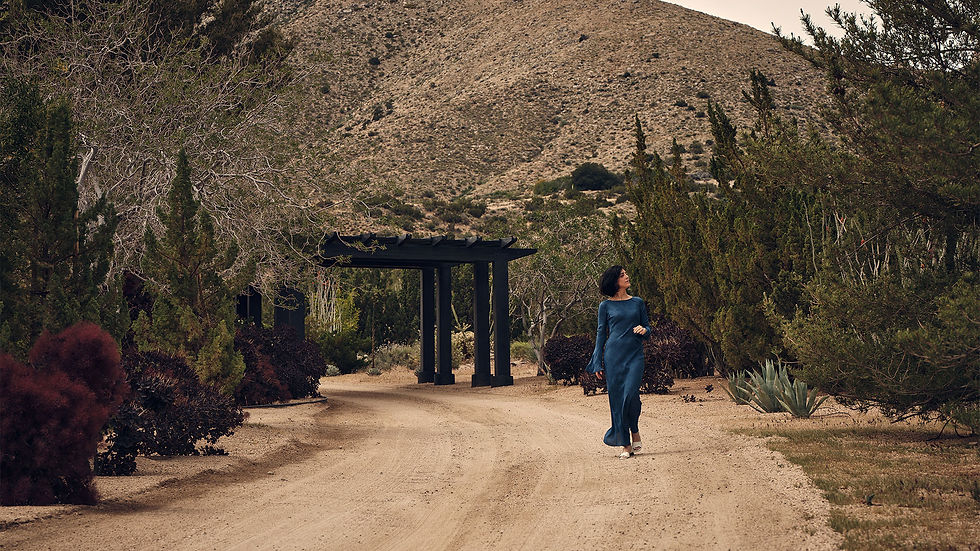
To illustrate beautifully how individuality and community can coexist, Michael cites as an analogy the grounds of Royal Way Spiritual Center.
In the fountains of the Zen Park, individual drops of water constantly mingle. One drop by itself creates very little. Together, the waters create movement, patterns, and beauty.
Then Michael points to the plant life.
The yucca remains a yucca. The juniper maintains its own boundaries. The cactus stands alone. Each plant has its own integrity, beauty, and power.
So the Ranch teaches two seemingly contrary lessons. On one hand, there is collaboration and mingling. On the other, there is individuality, privacy, and separation.
We need both. A spiritual community needs both, and a spiritual individual needs both.
Michael describes the Royal Way approach as one of “individuation and collective rather than togetherness.” We do not disappear into the group. In fact, the deeper we become as individuals, the more meaningful the collective becomes.
“Out of great individuation grows a collective,” Michael writes. “That collective is on a higher plane.”
Alone Without Spiritual Loneliness
This distinction also helps explain spiritual loneliness.
There may be periods when our path feels intensely personal. Perhaps people close to us do not understand what we are seeking. Perhaps meditation itself takes us into places that cannot easily be explained to anyone else.
That is okay.
The objective is not to avoid being alone. It is to become comfortable enough with ourselves that aloneness becomes spacious rather than frightening.
“Alone is not lonely,” Michael says. “Alone is al-one.”
Once we discover the silent self, something changes. Michael teaches that we can then carry that inner stillness anywhere, whether we are with another person, in a crowd, or in the middle of ordinary activity.
So Which Way Is Better?
It’s clear by now that both ways are valuable, beautiful, and necessary.
We need the aloneness that allows us to discover the silent self and experience God directly.
We need relationships and spiritual friendships that nourish our growth.
We can benefit enormously from a spiritual community whose collective energy supports us when our own energy, discipline, or clarity inevitably rises and falls.
And we benefit from the guidance of a teacher who can help us see beyond our own limitations and continue moving toward higher consciousness.
Ultimately, though, the work remains ours.
A community cannot do the journey for us. A mate cannot complete us. A teacher can guide us, encourage us, challenge us, and open doors, but we still have to walk through them.
In Royal Way, the goal is to become increasingly whole as an individual while participating fully with others. We develop the integrity of the cactus and the connectedness of the water.
We learn to be alone without being lonely. We learn to be together without losing ourselves. And through both experiences, we continue living to our highest potential, moving deeper into ourselves, closer to one another, and ultimately closer to God.


Comments